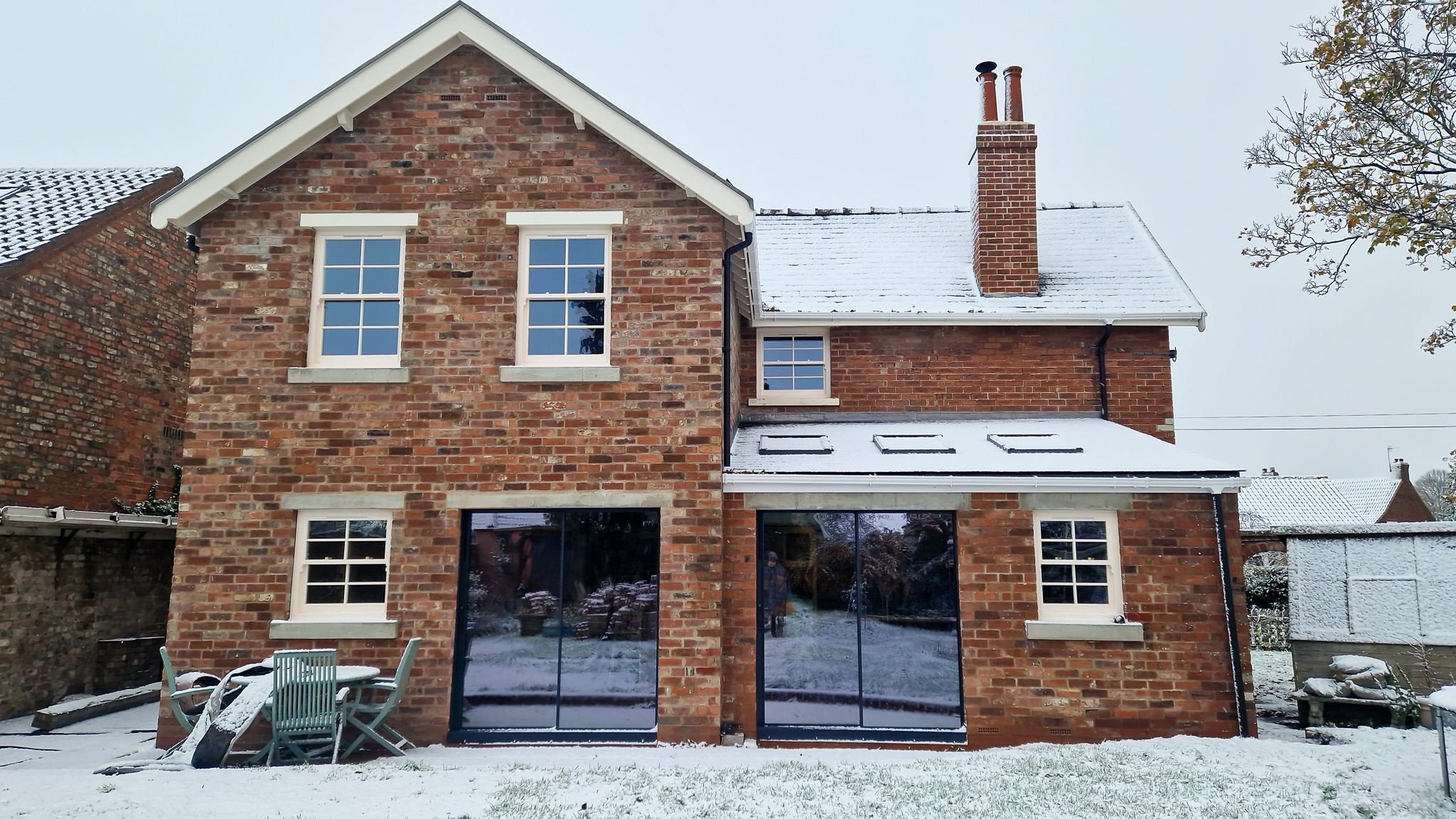
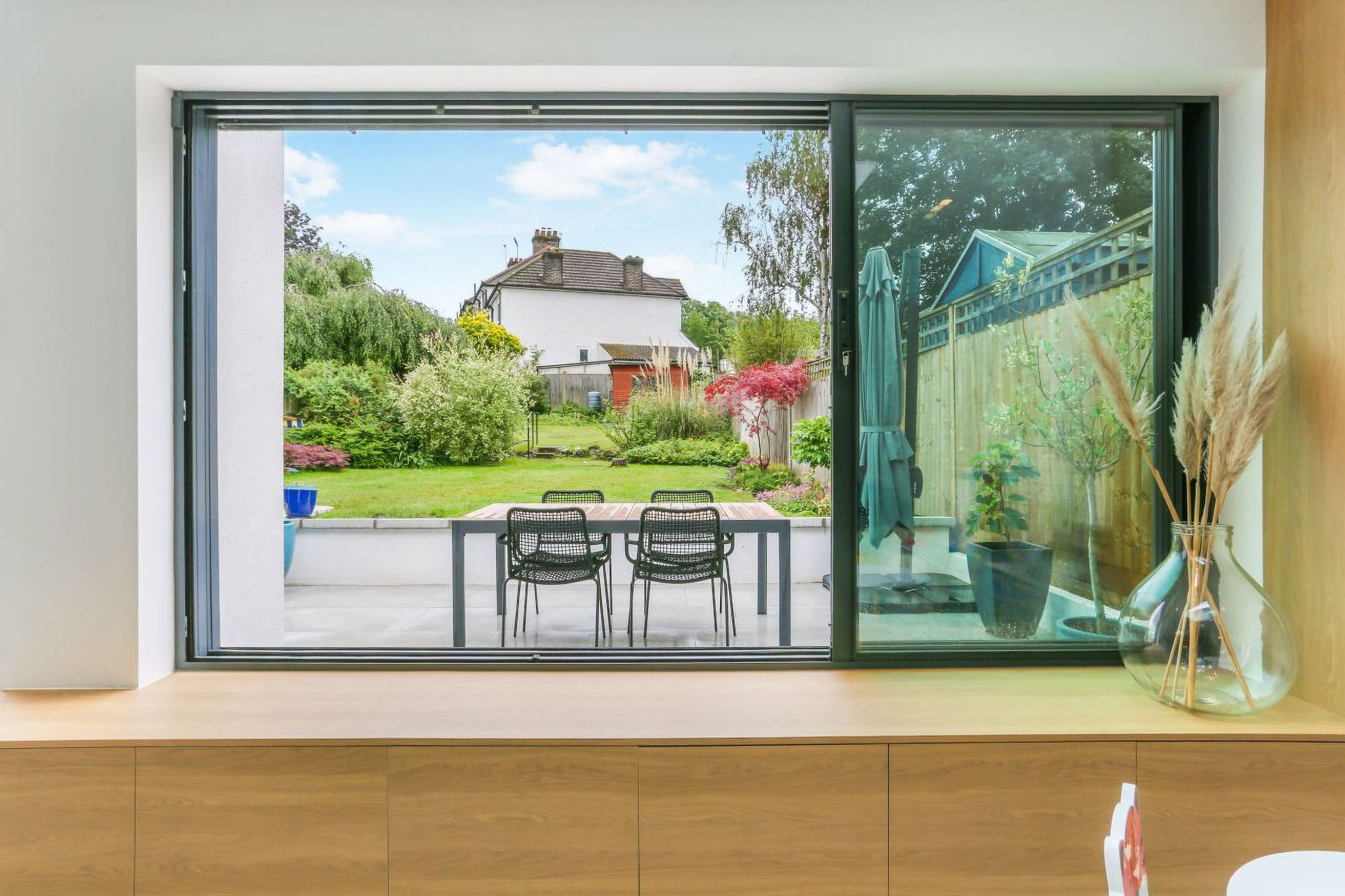
Minimal Sliding Window with matching doors in South Croydon
This gorgeous project in South Croydon, manufacturing a minimal sliding window with matching doors. Designed by KJC Architects.
Read the StorySlimline sliding doors are defined by one key principle: maximum glass, minimal visible aluminium. But not every door marketed as “slim” truly delivers meaningful reductions in sightlines.
In marketing terms, many sliding door brands state they are slimline, but the truth is, they concentrate only on the central mullion dimension. They conveniently ignore the rest of the product, because close examination shows them to not be standard door profiles and not slimline.
In technical terms, a slimline sliding door is typically classified by a central interlock of 20mm or less, combined with equally slim and carefully proportioned perimeter frames and sliding door rails.
In both marketing and technical terms, the central interlock is where two sliding panels meet. Reducing this dimension has the greatest visual impact because it directly affects your line of sight.
At Glideline, our GS20, GS15 and new Aspect sliding doors are all engineered around the principle of minimum frame, maximum glass and visual impact.
However, understanding what makes a sliding door genuinely slimline requires looking beyond the interlock alone. This is essential in how you choose what is actually a true slimline sliding door and not a product focusing on the central interlock only.
As we’ve mentioned, most discussions focus purely on the central mullion. That is only part of the sliding story.
A sliding door’s visible aluminium is made up of several components:
Central interlock (where sliding panels overlap)
Outer frame jambs (left and right vertical frames)
Head frame (top)
Threshold or base track
Vertical stiles on fixed panes
Top and bottom rail depth of each sliding sash
Each contributes to how much aluminium you actually see once installed.
This is the most important visual dimension.
Traditional sliding systems: 35mm to 83mm or more
Slimline systems: 20mm, 18mm or less
Reducing this measurement significantly improves sightlines across large openings. When you are looking directly out into a garden or landscape, that central interruption becomes visually critical. The central interlock is vital on a two panel door, being central. On a three panel product, you’ll see two vertical mullions, and again important.
However, a 20mm interlock alone does not automatically mean 90% glass. The surrounding frame must also be proportioned correctly. And how much frame you see depends on whether your door is going into an existing opening or a new one.
The outer frame is the exterior perimeter frame of every sliding door. It is the outer frame that sits within the structural opening. Some sliding door brands are intended for new openings only. Therefore, you can hide part of this frame within the cavity of the wall. New build homes and extensions are a good example of new openings.
In practical terms, when you fit a door to an existing opening (surface mounted), typical visible dimensions with most sliding doors are:
Visible outer frame jamb: typically 60–80mm or more
Head frame: often similar dimension up to 80–100mm or more
Threshold: varies depending on whether flush or standard design, from 60–80mm or more
When the frame is recessed into the wall, the visible outer frame aluminium can be reduced significantly. Typical visible dimensions range from 28mm down to virtually single figure visible aluminium just so you can open the doors, with the entire outer frame hidden.
Therefore, a properly designed slimline system considers how the frame looks when fitted into an existing opening, where you can’t hide the frame, as well as how it looks when hidden into the structure. Remember it is not just about the panel interlock.
When we talk about sliding door rails we mean the horizontal top and bottom profiles on your moving panel. These are designed at the top to keep the door tight in the frame and at the bottom a place for the rollers, sealing and other components.
Door stiles relate to the vertical profiles on your moving panel. Depending on the door design, these stiles can have the main lock and handle, no handles or one side comprises the central interlock.
Therefore, each sliding panel consists of:
Four vertical stiles on a two panel, six on a three panel etc.
One top and bottom rail per sliding panel
Glazing beads to hold the glass in place
No beads with a fully glass bonded construction
Genuine slimline systems minimise these elements to as small as possible, while ensuring your new sliding door structural strength, movement, security and safety is maintained. This is critical because where you fit your new sliding door affects the choice of product you buy.
For example, a door at the back of a suburban house, sheltered by other properties on all sides won’t be under the same stresses as a sliding door on a hillside, clifftop, or countryside location where it is unsheltered and exposed to all the elements.
Therefore, sliding doors in exposed locations must resist:
Wind loading
Glass weight (often 200–300kg per panel)
Daily operational stress
Wind loading on a sliding door is the measurement of pressure (measured in Pa or Pascals) exerted by wind against the door’s surface. This tests the door’s ability to withstand the known forces in your area, without damage, breaking, blowing in, or allowing excessive air/water infiltration.
Glass weight is also very important with slimline sliding doors. The highest end sliding doors are designed to take glass weights of up to one tonne. This substantial weight must be supported by quality hardware and also slide open and closed in a safe manner.
Daily operation stress is the everyday usage of doors. Some doors are used more than others as potentially the only access door out to the garden. So, your new slimline sliding doors must be designed in such a way that they’ll be reliable not just during their guarantee but long into the future as well.
When you choose a new sliding door for your home, it is rarely just about how they look. Engineering tolerances, design, manufacturing quality, testing and ensuring your doors are fit for their location matter. Excessively reducing profile mass without reinforcement significantly compromises your doors.
Marketing often claims “up to 90% glass”. That number only makes sense when viewed against a specific opening size and configuration.
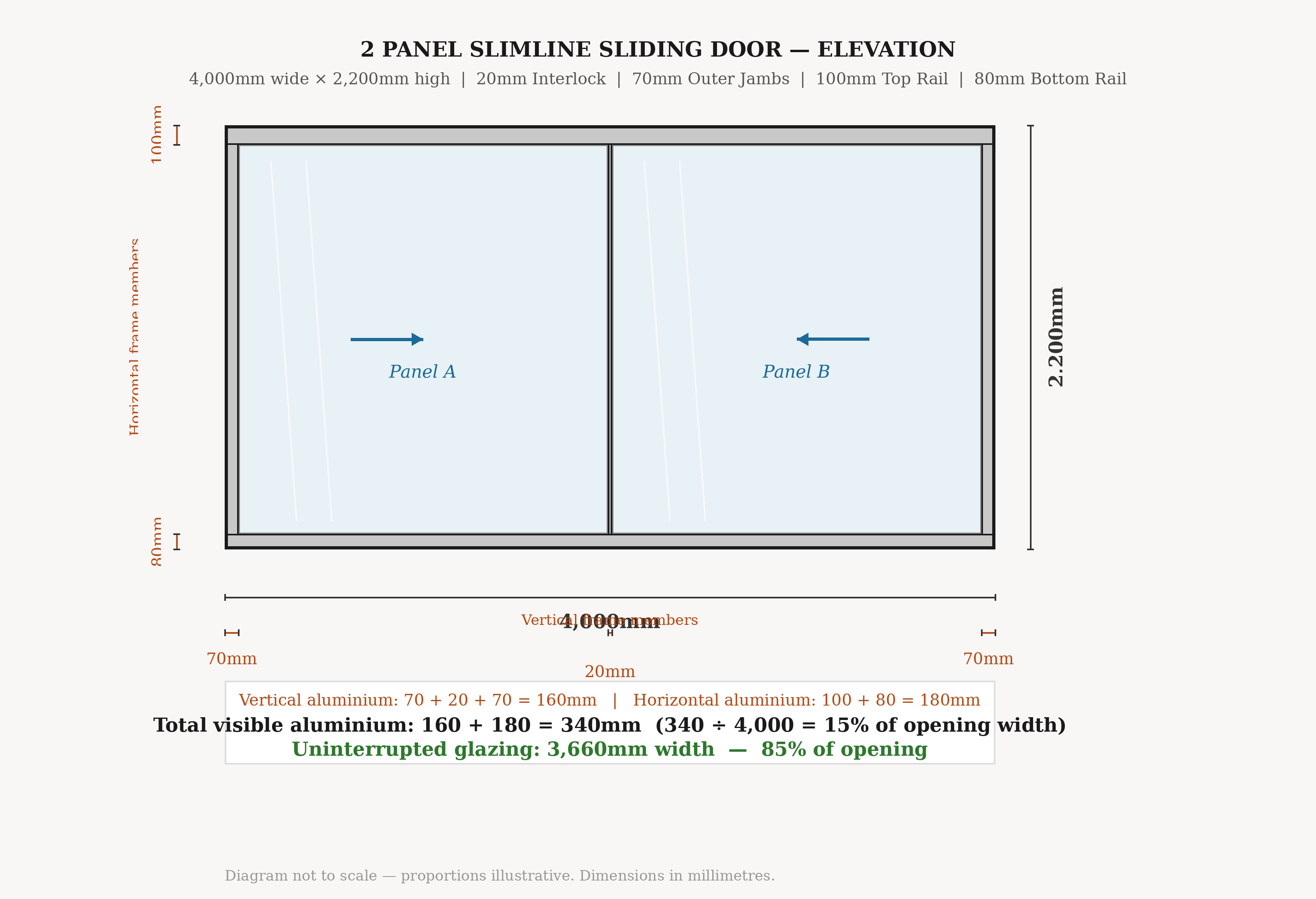
Let’s model a realistic example, based on an opening 4,000mm wide × 2,200mm high.
Assume:
Central interlock: 20mm
Visible outer jambs: 70mm each side
Total visible vertical aluminium: 70 + 20 + 70 = 160mm
Total visible horizontal aluminium: 80 + 100 = 180mm
Total: 340mm
Percentage of total width: 340 ÷ 4000 = 15%
This means 85% of the opening width is uninterrupted glazing and minimal framing.
Same opening, 4,000mm wide × 2,200mm high. Assume typical figures:
Two outer frame + sash zones: 140mm each
Two central meeting stiles: 154mm each
One outer frame and top rail: 108mm
One track and bottom rail: 95mm
Total visible vertical aluminium: 140 + 154 + 154 + 140 = 588mm
Total visible horizontal aluminium: 203mm
Total: 791mm
Percentage of total width: 791 ÷ 4000 = 19.8% ≈ 20%
That is nearly four times the visible vertical aluminium compared to the slimline slider.
791mm − 340mm = 451mm of additional frame.
That equates to nearly 57% more solid material across the opening before considering hinge lines and gasket shadowing.
On a 4m opening:
A slimline slider presents three vertical interruptions and two horizontals (left frame, 20mm centre, right frame).
A three panel bifold presents four much thicker vertical interruptions plus hinge detailing and two horizontals.
The visual result is noticeably different, particularly in contemporary architecture where horizontal sightlines are important.
This does not make bifolds inferior. Bifolds offer near full aperture opening when fully folded. But when closed, their geometry inherently introduces more vertical structure.
If the design priority is uninterrupted view when closed, sliding doors have a structural advantage.
The same principle applies when comparing slimline sliders to older or heavier sliding systems and those which are marketed as “slimline” but don’t have smaller dimensions.
A typical standard sliding door has:
A 44–77mm central mullion
Wider stiles with outer frame
Thicker sash profiles with outer frame and track
Using the same 4m door example: if the central mullion increases from 20mm to 60mm, an additional 40mm is lost through the centre. That may sound minor, but over large architectural openings, these proportions become visually dominant.
The same applies for the horizontal and vertical profiles. Typical standard sliding doors show a visible aluminium profile of around 116mm at the top of the doors and 124mm at the bottom. They are also about 120mm thick at each end of the doors.
A genuine slimline sliding door only shows around 57mm on each side, more than 50% slimmer.
When you are looking for genuine slimline sliding doors, do not just concentrate on the central profile. Ask for the dimensions of the entire door set, horizontal and vertical.
Glass percentage claims must consider:
Overall opening width
Panel configuration (2, 3, 4 panels)
Whether panels stack behind fixed panes
Whether outer frames are recessed or face fixed
For example, a 2-panel 4m slider with a 20mm interlock may achieve 94–96% visible glass horizontally. A 3-panel configuration introduces an additional vertical profile. A 4-panel configuration more than doubles the points where the door meets and locks in the middle. As panel count increases, so does visible aluminium.
Therefore, slimline design is most visually effective when panel count is kept minimal and panel widths maximised. Slimline doors have thin profiles all around the door, not just the middle. This is where engineering capability matters: if your new doors cannot safely carry larger panels, more vertical breaks become necessary.
Reducing sightlines must not compromise:
Structural integrity
Glass load performance
Weather classification
Long term alignment
Sliding doors operate differently to windows. They carry significant glass weight and rely on precision rollers and track alignment. Calculations must also be done to ensure they are right for the location.
Slimline systems must therefore balance:
Minimal aluminium
Reinforced structure
Controlled deflection
Reliable long term operation
This is where true product development differs from rebadged systems.
Slimline does not mean a compromise on thermal performance. A common misconception is that minimising frame reduces insulation, but a well-engineered slimline system is designed to perform as a complete thermal unit.
Modern slimline sliding doors typically include:
Thermally broken aluminium frames that reduce heat transfer across the profile
Additional thermal inserts for higher-performance specifications
Double or triple glazing with low-E coatings, solar control, argon or krypton fills, and the latest vacuum glazing units
Warm edge spacers around the glass to limit condensation and improve insulation
Because so much of a slimline door is glass rather than frame, the glazing specification carries most of the thermal load. The GS20 achieves centre pane U-values from 1.3 W/m²K with the appropriate glass build-up; whole-door U-values will depend on door size, configuration and whether the frame is recessed into the structure or face fixed. When the frame is recessed, thermal performance improves further because the insulated frame sits within the thermal envelope of the wall.
For projects working towards higher energy standards — including the forthcoming Future Homes Standard, Passivhaus or low-carbon retrofits — slimline systems can be specified to suit. Always ask for both centre pane and whole-door U-value figures, and check full system certification, as these give a far more accurate picture than a single headline number.
Aluminium is one of the most sustainable framing materials available. It is fully recyclable without any loss of strength or quality, so frames can be reclaimed and reused at the end of their service life rather than sent to landfill.
Many manufacturers now use recycled aluminium content in their profiles, and modern powder coating processes have become cleaner thanks to improvements in pre-treatment and finishing. Combined with the energy savings delivered by high-performance glazing, a well-specified slimline sliding door makes a sound case for environmentally conscious projects — particularly where a build is targeting sustainability certification or eco-build credentials.
Durability matters here too. A slimline door that is correctly engineered for its location will last for decades with minimal maintenance, and a product that does not need replacing is the most sustainable outcome of all.
For trade professionals, the choice of slimline system impacts:
Survey tolerances
Handling weight
Site protection
Adjustment time
Callbacks and long term servicing
A 20mm interlock is not just a design feature. It reflects engineering philosophy.
Slimline sliding doors should be chosen not just for how they look on a brochure, but for how they perform under real-world load conditions.
The GS20 is Glideline’s benchmark slimline sliding door system, engineered for maximum glass and long-term performance. Key specifications at a glance:
Specification | GS20 Performance |
|---|---|
Central interlock | 20mm |
Max panel width | 2,500mm |
Max panel height | 3,000mm |
Max glass weight per panel | 320kg |
U-value (centre pane) | From 1.3 W/m²K |
Air permeability | Class 4 |
Water tightness | Class 7A |
Wind resistance | Class C5 |
Security | PAS 24 available |
Panel configurations | 2, 3, 4, 5 and 6 panel |
Outer frame visible (surface fix) | From 57mm per side |
Top rail visible | From 80mm |
Bottom rail / threshold | From 100mm (flush option available) |
Finish | Powder coat, RAL colour range |
Full technical specifications, test reports and downloadable data sheets are available on the GS20 product page.
Slimline performance should not limit design choice. The GS20 is available in a full range of configurations and finishes to suit contemporary and traditional projects alike.
Available in the full RAL colour range as standard, with dual colour options (different inside and outside) for projects where internal and external aesthetics differ. Popular choices include Anthracite Grey (RAL 7016), Pure White (RAL 9010) and Jet Black (RAL 9005).
A choice of inline and projecting handle styles in matching or contrasting finishes. Inline handles sit flush with the frame face, maintaining the slimline aesthetic when doors are closed.
The GS20 is available with a standard threshold or a low-profile flush threshold option, which significantly reduces the visual step and improves accessibility. Flush thresholds are suitable for most domestic applications.
Standard sliding configurations include:
OX — one fixed, one sliding panel
XX — two sliding panels (most common on 4m openings)
OXO — two fixed outer panels, one central sliding panel
OXX — one fixed outer panel, two sliding panels
OXXO — two fixed outer panels, two sliding panels
Multi-panel up to 6 panels for wider openings
Panel stacking direction can be configured to suit site access and opening preference.
A slimline sliding door is an aluminium sliding door system engineered to minimise visible frame. The defining characteristic is a central interlock of 20mm or less, at the point where two sliding panels meet in the closed position. A genuine slimline sliding door has thin proportions at all frame dimensions, not just the interlock.
The GS20 operates at a 20mm central interlock. Our GS15 system reduces this further to 15mm. For context, standard sliding door systems typically show 35–80mm or more at the interlock.
The GS20 can accommodate panels up to 2,500mm wide and 3,000mm high, with individual panel weights up to 320kg. Total opening widths of 8m and beyond are achievable across multi-panel configurations, and Glideline can offer doors that go wider and taller if required. For a fuller explanation, see our guide on how wide sliding doors can be.
Yes. The GS20 is available with PAS 24 enhanced security specification. Thinner frames do not compromise security when the system is correctly engineered — locking points, frame reinforcement and hardware must all be designed as an integrated system.
The GS20 achieves centre pane U-values from 1.3 W/m²K with appropriate glazing specification. Overall door U-values will vary depending on the glass specification, door sizes, and whether the frame is hidden in the wall or face fixed.
The key difference is visible frame when closed. A slimline slider on a 4m opening shows around 15% visible frame. A comparable three panel bifold typically shows 20% or more. Bifolds offer a wider clear aperture when fully folded; sliders provide a better uninterrupted view when closed. The right choice depends on whether the priority is maximum view or maximum open doors — we explore this further in our guide to the alternatives to bifold doors.
In most cases, no. Replacing like-for-like or installing in a new opening within permitted development guidelines does not usually require planning permission. However, listed buildings, conservation areas and properties with specific planning conditions may have restrictions. Always check with your local planning authority if in doubt.
We recommend the use of a trained surveyor. In very broad terms you can measure the structural opening width and height at three points — left, centre and right for width; top, middle and bottom for height — and use the smallest dimension. Allow for any rebate or frame overlap. For surface-fixed installations, measure the clear daylight opening. Glideline’s trade team can advise on survey tolerances for the GS20. You should always seek professional advice where you are creating a flush or minimal track.
Slimline sliding doors require minimal maintenance. Tracks and rollers should be cleaned periodically to remove debris, and rollers checked for alignment annually. Powder coat finishes are durable and require only occasional washing. Avoid abrasive cleaners on aluminium surfaces. We have also engineered our doors to be simple to clean, with some products offering removable caps to clean below a flush level.
Yes. Corner sliding configurations are possible with the GS20 and other products, allowing two runs of glazing to meet at a corner with no structural post. This is one of the most striking applications of slimline sliding door technology and requires careful structural consideration at the design stage and in collaboration with a competent builder. You can also have open corner doors where the post is inside or outside, still supporting the roof, but unconnected to the doors.
Yes, provided the correct specification is chosen and proper structural calculations are carried out. The GS20 carries a Class C5 wind resistance classification. For exposed coastal, hillside or high-rise locations, we recommend a full structural assessment and wind load calculation before specifying. Our technical team can support this process.
A lift-and-slide door uses a handle mechanism that lifts the panel onto its rollers before sliding, allowing heavier panels and tighter seals. Slimline sliding doors operate on a simpler roller system. Lift-and-slide systems can achieve excellent weather performance, but the handle mechanism and frame geometry are typically different to a pure slimline system. Lift-and-slide doors are, by design, usually thicker products.
At Glideline, we supply slimline sliding doors to trade professionals nationwide. Whether you’re a builder, architect, installer or glazing contractor, our team is set up to support you from survey through to delivery.
Why installers choose Glideline:
Supply-only nationwide delivery to site or depot
Dedicated trade account management
Technical support at survey, specification and installation stage
Consistent manufacturing tolerances that reduce adjustment time on site
Full documentation including test reports, installation guides and product data sheets
Long-term product support and spare parts availability
We’ve built our reputation on being the sliding door specialist. Not a generalist supplier with sliding doors as one line in a catalogue, but a business that has made slimline sliding doors its focus.
To discuss a project or request a quote, contact our trade team or visit the GS20 product page for full specifications.
View full GS20 specifications →
Request a trade quote →
At Glideline, we’ve mastered slimline sliding doors to become one of the most trusted sliding door specialists. Contact us today for more information on our entire range of sliding doors.
Related: GS20 Slimline Sliding Door System · How Wide Can Sliding Doors Be? · GS20 Slimline Sliding Doors — York Extension
Continue your research
Use the new Slimline hub to move from this guide into product specifications, sightline comparisons and completed installations.
Have an opening to price?
Send the sizes, location and preferred configuration and Glideline will help identify the appropriate system.
This gorgeous project in South Croydon, manufacturing a minimal sliding window with matching doors. Designed by KJC Architects.
Read the Story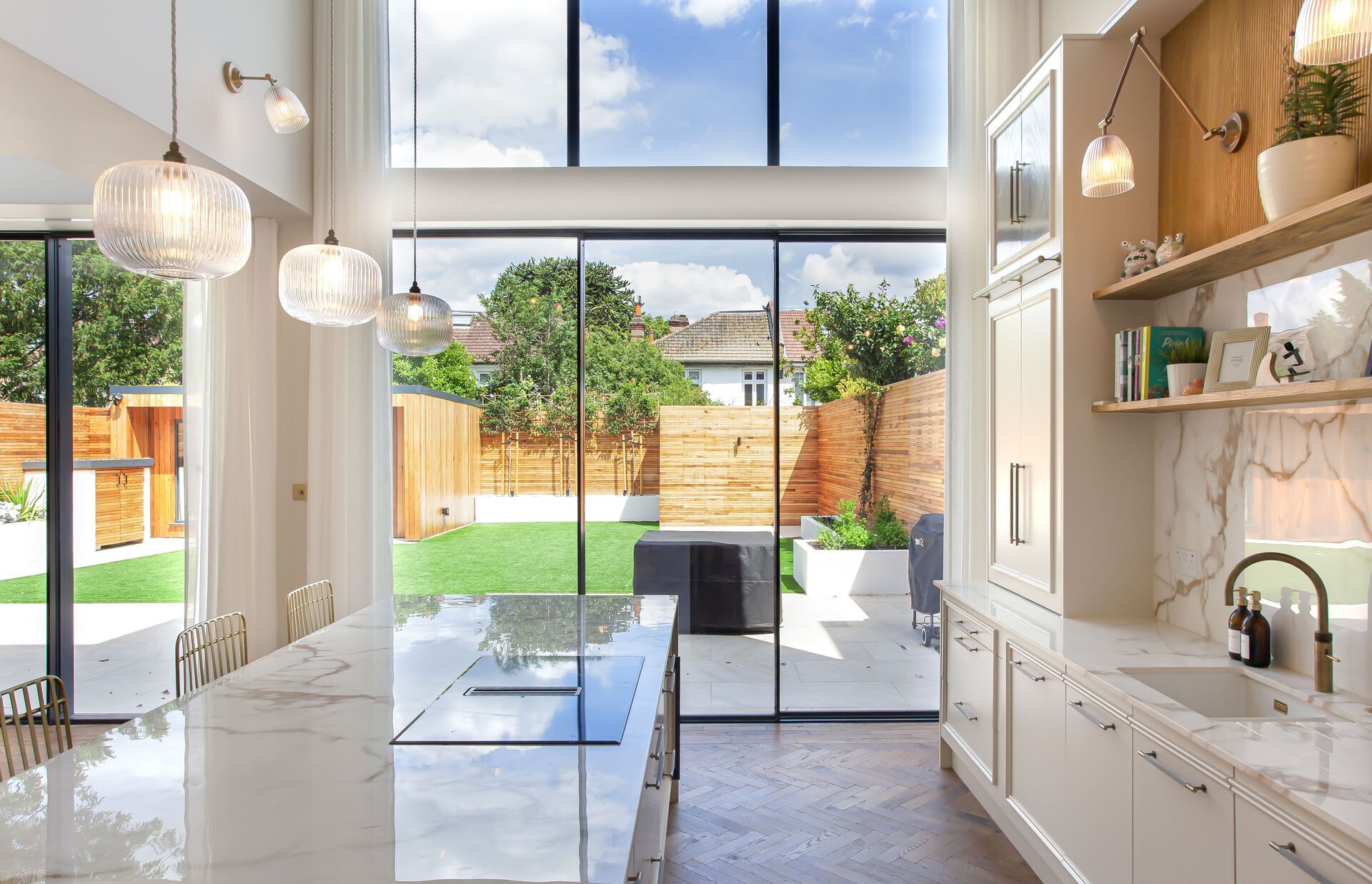
Looking for Cortizo sliding doors? Glideline manufactures and enhances Cortizo aluminium sliding doors for UK homes, weather, drainage, hardware, installation and long-term performance.
Read the Story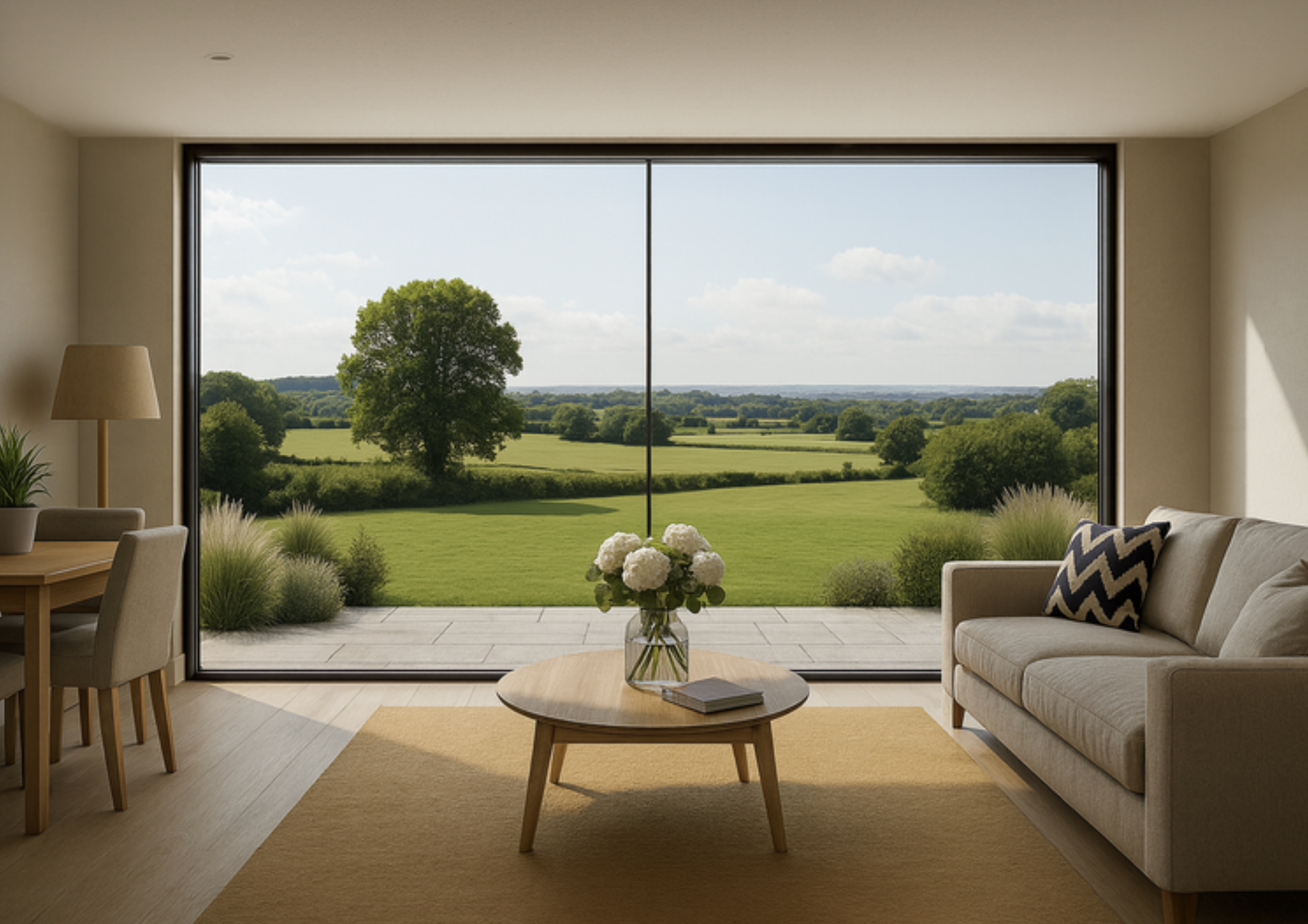
Our latest Aspect Sliding Door changes that assumption. We are proud to have designed the UK's slimmest beaded aluminium sliding door, and it arrives with an outstanding 15mm interlock
Read the Story